Pregnancy
Perineal Massage in Pregnancy: A Pelvic Floor PT's Guide
November 3, 2026 9 min read
Preparing for a vaginal birth often brings up a very practical question: What can I do now to help my body prepare?
At Revelle Physical Therapy, perineal massage is one part of that preparation. We teach it alongside breathing, pelvic floor relaxation, and positions for labor and delivery—with an emphasis on helping you understand where to apply pressure, what you should feel, and how to practice comfortably at home.
The quick answer: Perineal massage is a gentle stretch of the tissue between the vaginal opening and the anus that helps prepare it for a vaginal birth. It's a skill best learned with guidance. At Revelle, we teach patients to begin around 34 weeks of pregnancy and to practice for about five minutes daily, adjusting the plan to each person's body and comfort. Research suggests it may lower the chance of tearing that needs stitches, especially with a first vaginal birth.
Here is how we approach it with our patients.
Book a visit if any of the following sound like you:
Georgia and Colorado are direct-access states. You do not need a physician referral to book a pelvic floor PT evaluation with us.
The perineum is the area of skin and muscle between the vaginal opening and the anus. During a vaginal birth, this area stretches to allow your baby to pass through.
Perineal massage uses gentle pressure at the lower part of the vaginal opening to stretch these tissues in preparation for birth. It also gives you an opportunity to become familiar with the sensation of stretching while practicing pelvic floor relaxation.
We focus on both parts: the stretch itself and your ability to relax in response to it. In our sessions, we help you find an amount of pressure that allows you to keep breathing comfortably rather than holding your breath or tightening against the stretch.
You may have heard tears described by “degree.” These terms refer to the tissues involved:
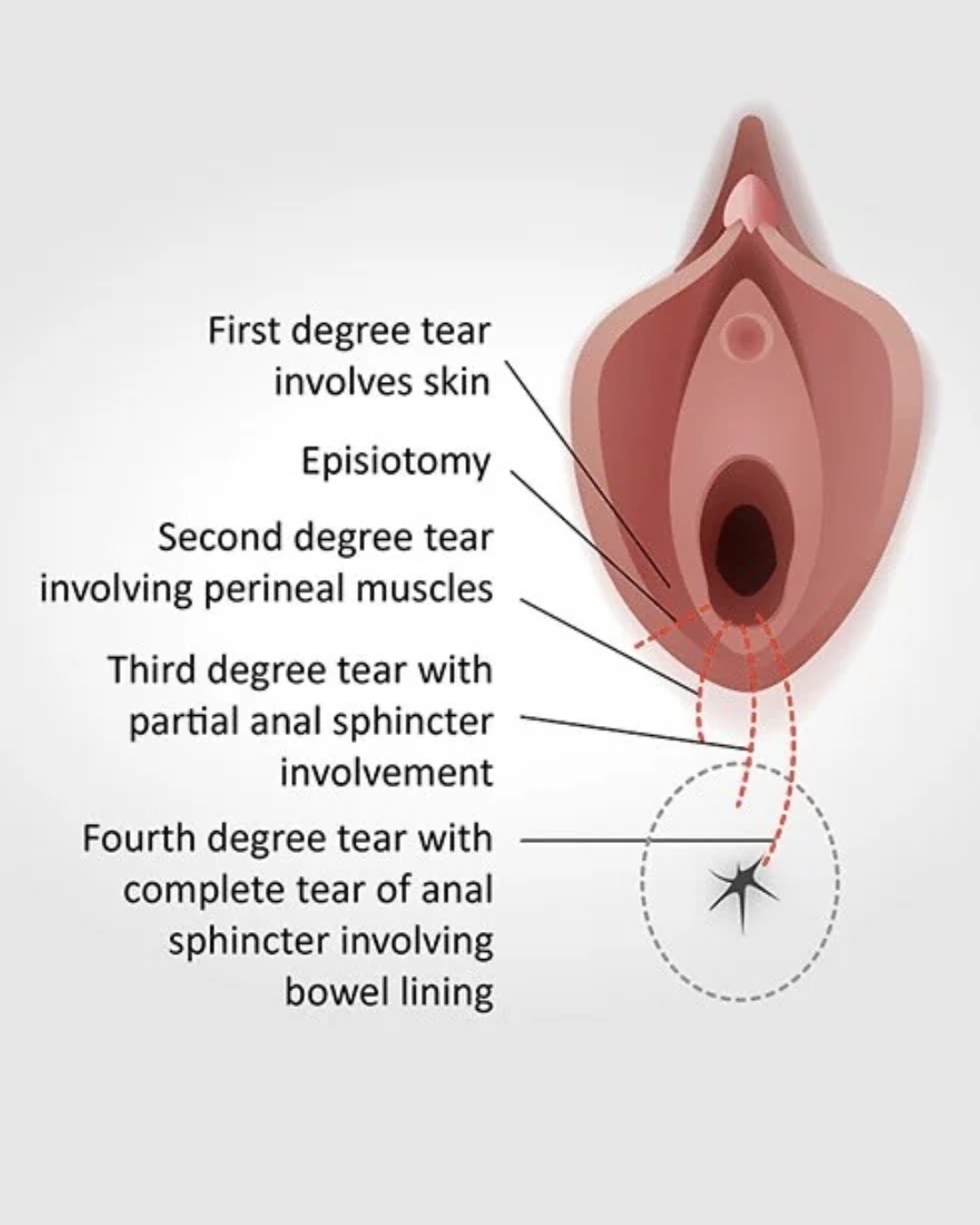
An episiotomy is different: it is a surgical incision made by a birth provider rather than a spontaneous tear. Understanding these distinctions can help you make sense of conversations about birth preparation and recovery.
Research supports some benefits, particularly before a first vaginal birth. A Cochrane review found that antenatal perineal massage reduced episiotomies and overall perineal trauma requiring stitches. It did not demonstrate a clear reduction in third- or fourth-degree tears. Perineal massage can be a useful preparation tool, but it cannot guarantee a tear-free birth.
Your risk of tearing also depends on factors beyond your preparation, including whether this is your first vaginal birth, your baby’s size, and whether an assisted delivery is needed.
At Revelle, we approach perineal massage as one part of a broader birth-preparation plan—not as a single technique that determines your outcome. A tear does not mean you practiced incorrectly or did not do enough.
At Revelle, we generally begin teaching perineal massage at 34 weeks, with a home-practice goal of about five minutes a day until labor begins, provided your birth provider has confirmed that vaginal insertion is appropriate for your pregnancy. We introduce the technique in your appointment so you can ask questions, practice the positioning, and understand the pressure before trying it on your own.
Recommendations vary slightly: Cambridge University Hospitals advises starting from 34 weeks, while the Royal College of Obstetricians and Gynaecologists recommends starting from 35 weeks.
We encourage patients to think of home practice as a brief, repeatable stretching routine. The aim is not to accomplish everything in one session, but to make the technique and the sensation more familiar over time.
Five minutes daily is our usual home-program goal—not a requirement you must meet to benefit. Research has found benefit with less frequent practice, including once or twice weekly. Missing a day does not mean you need a longer or more intense session the next day.
Check with your OB or midwife before starting, especially if you have been advised to avoid vaginal insertion, have placenta previa, or have concerns about preterm labor. Do not perform perineal massage if you have vaginal bleeding, an active vaginal infection or herpes outbreak, or if your waters have broken or may be leaking.
Wash your hands, keep your nails short and smooth, and use lubricant to reduce friction. If you are using a massage tool, follow its instructions for cleaning, lubricant compatibility, and use.
Stop if you experience sharp or increasing pain. Contact your maternity care team promptly about bleeding or suspected fluid leakage rather than continuing the massage.
Our approach includes two complementary techniques: gentle, sustained stretches and slow, U-shaped sweeping motions that maintain a gentle stretch as you move. You can alternate between the two throughout your session.
A supported, semi-reclined position on your bed is a good starting point. Place pillows behind your back, bend your knees, and let them rest comfortably apart. You should feel supported rather than working to hold yourself upright.
Some of our patients prefer practicing in the shower because the warm water feels soothing and makes it easier to connect massage with an existing routine. Others find standing makes it harder to relax. Either approach can work; the position should make the technique easier, not more strenuous.
For shower practice, use a stable, nonslip position with one foot resting on a low, secure ledge—not a loose chair or an unstable surface. Keep lubricant off the floor. If reaching or balancing feels awkward, choose a supported position after your shower instead.
Imagine 12 o’clock toward your pubic bone and 6 o’clock toward your perineum and anus.
You will work around the lower half of that clock: from approximately 3 o’clock, down through 6 o’clock, and across to 9 o’clock. This is the area we focus on—not the upper portion near the urethra.
Apply lubricant to your thumb and place it just inside the vaginal opening at 6 o’clock, approximately to your first knuckle. You are working near the opening, not reaching deeply into the vagina.
Gently press downward toward the perineum until you feel a tolerable stretch. Hold for about 20–30 seconds, breathing slowly and allowing the muscles to soften.
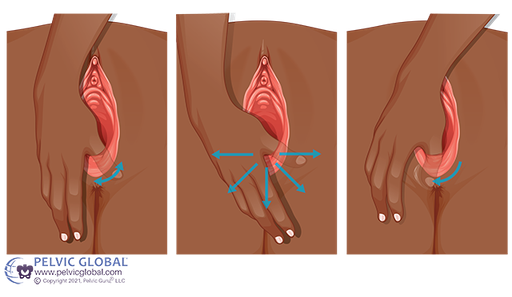
Image used with permission from Pelvic Guru®, LLC as a Pelvic Global Member
Then move slightly to one side—toward 5 and 4 o’clock—and repeat. Work toward 7 and 8 o’clock on the other side, gradually covering the lower half of the opening.
The order does not need to be exact. What matters is controlled pressure and your ability to stay relaxed as you move from one area to another.
Starting near 6 o’clock, gently sweep your thumb toward one side and then the other, following the lower half of the opening in a U shape.
Maintain a little downward-and-outward pressure as you move. The motion should include a gentle stretch—not simply slide across the surface of the skin.
Alternate between a few sustained holds and a few slow sweeps throughout your session. You do not need a set number of repetitions or a more forceful stretch each time.
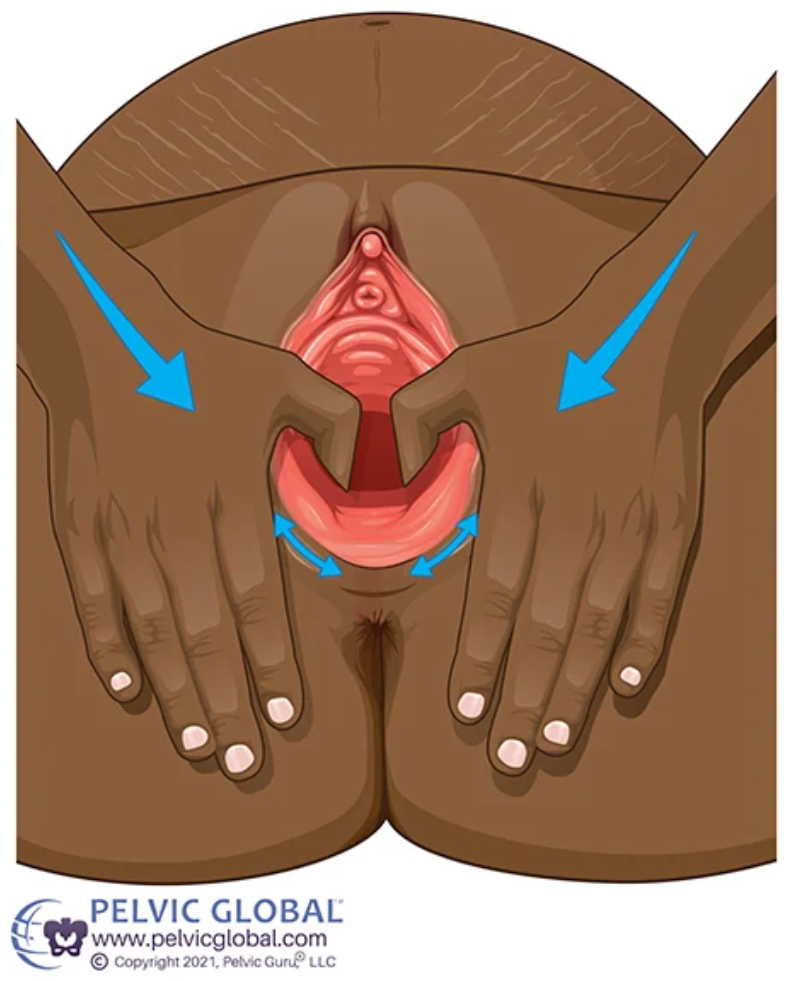
Image used with permission from Pelvic Guru®, LLC as a Pelvic Global Member
You may notice a pulling sensation, tightness, or mild discomfort, especially when the technique is new. It should not feel sharply painful, and you should not have to force yourself through it.
At Revelle, we use about 3 out of 10 discomfort as an upper limit, not a target. This is a practical guide we use in teaching—not a research-established threshold everyone needs to reach.
Pay attention to how your body responds. If you are clenching, holding your breath, or pulling away, reduce the pressure or stop. The purpose is to practice a stretch you can relax into, not to tolerate as much discomfort as possible.
If you consistently struggle to find a comfortable amount of pressure, bring that feedback to your PT. We can help adjust your positioning and technique rather than asking you to push harder.
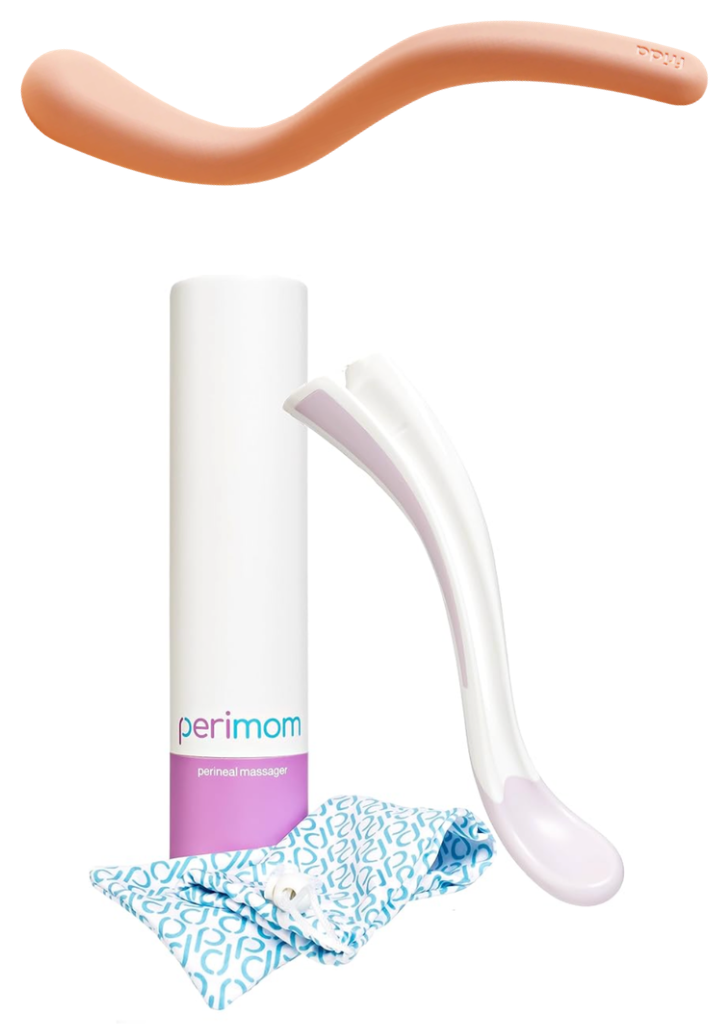
As your belly grows, reaching comfortably with your hand can become challenging. A purpose-designed perineal massage wand can help by acting as an extension of your hand.
At Revelle, we often recommend the Frida Mom perineal massage wand because we like its softer feel, and we carry it in our offices. That is a clinical preference; you do not need to purchase a tool to practice perineal massage. (Pictured: Perimom and Frida Mom perineal massage tools.)
The same general principles apply: work around the lower portion of the opening, use controlled pressure, and stay within a comfortable stretch. Ask your PT to demonstrate your specific tool, and follow the manufacturer’s instructions for the intended massage end, insertion depth, and cleaning. Frida’s instructions describe U-shaped massage and targeted pressure using the widest part of the wand.
Yes. Partner assistance is an option when reaching is difficult or when you would simply prefer some help.
In a supported, reclined position, your partner can use clean, lubricated thumbs or fingers at the lower portion of the vaginal opening. The same gentle downward-and-outward pressure and U-shaped movement apply, with you directing the pressure throughout.
It helps to discuss the purpose beforehand: this is birth preparation, and it does not need to become sexual. Agree on what feels comfortable, communicate as you go, and make sure requests for less pressure or a pause are followed immediately. Partner involvement should make the process easier and more comfortable for you.
At Revelle, we often see patients weekly during this stage of birth preparation, depending on their needs. These appointments give us an opportunity to check how home practice is going, address areas of discomfort, and adjust the technique as you become more comfortable.
Home practice reinforces what you learn in your visits. Rather than arriving each week unsure of where to start, you can tell us what feels easier, where you still notice tension, and which positions work best for you.
Progress is individualized. It may mean finding a more comfortable position, becoming more familiar with the stretch, or learning to relax without holding your breath—not simply using more pressure. Internal assessment and treatment are always optional and require your consent.
We also work on breathing, labor positions, and pushing coordination so that perineal massage fits into a broader preparation plan.
You do not have to figure out perineal massage from written instructions alone.
At Revelle Physical Therapy, we offer pregnancy care in Chamblee and Alpharetta, Georgia, and Greenwood Village, Colorado. Our approach includes teaching the technique, helping you find a comfortable position, and giving you a clear plan for practicing at home.
Schedule a pregnancy pelvic floor PT visit for guidance tailored to your body, your questions, and your birth preparation goals. You can also take our 2-minute pelvic health quiz, explore childbirth education, or read more about pelvic floor physical therapy during pregnancy.
Start with a free 10–15 minute phone consult, or book a 1:1 visit at Revelle — Atlanta (Chamblee + Alpharetta) or Denver.
Visit us in Atlanta (Chamblee), Alpharetta, or Denver.
A 1-page guide from our DPTs — what to actually expect at week 1, 6, and 12 postpartum, and the real signs you'd benefit from pelvic floor PT. No fluff. No fear.
Six weeks postpartum, your OB clears you and the symptoms are still there. A North Atlanta DPT on what real postpartum pelvic floor recovery looks like — and why the suburban insurance-mill model keeps falling short.
Read LocalIf your last pelvic floor PT in Atlanta involved 15 minutes with a tech and a stack of resistance bands, that is not what the research says works. Here is what a 60-minute 1:1 session actually looks like — and why it matters for results.
Read